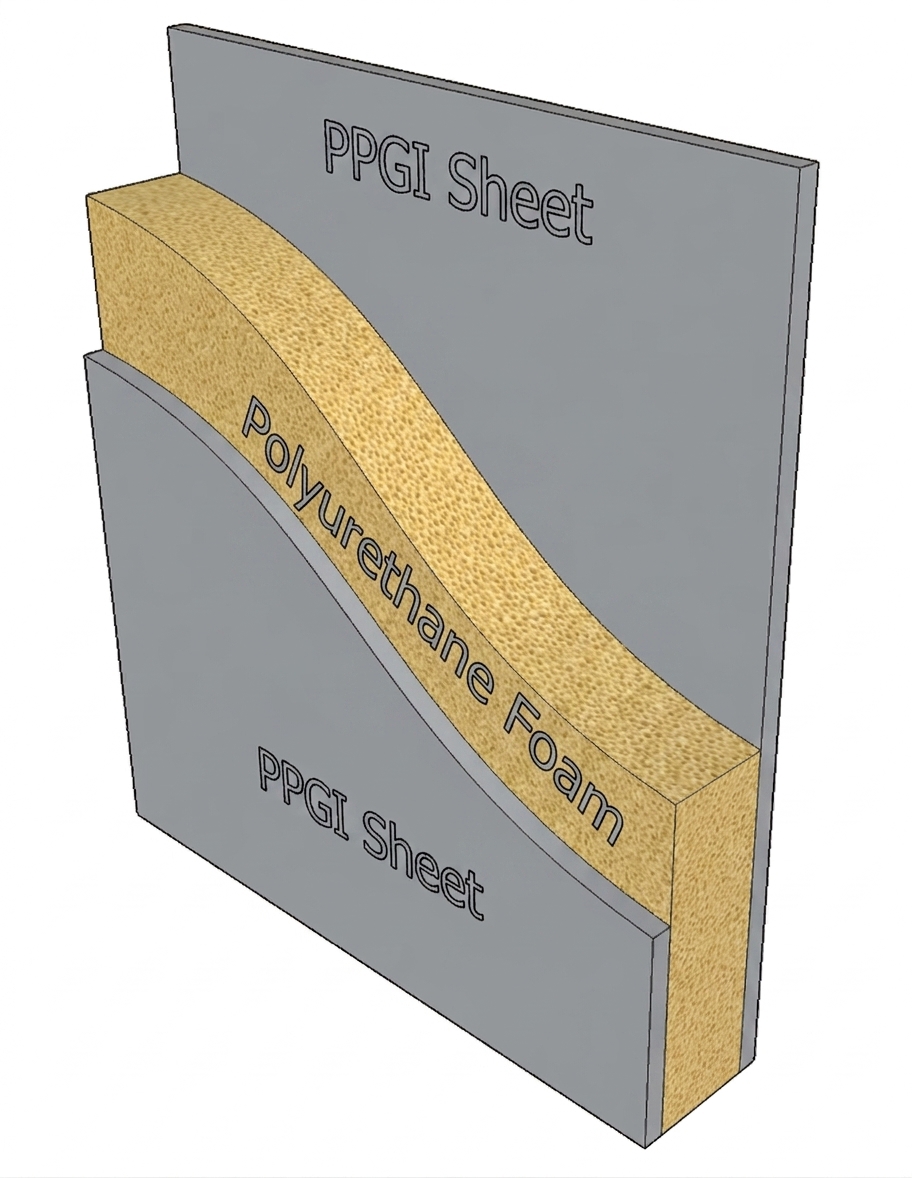
Cold storage facilities are only as good as their insulation. Pick the wrong panel thickness or core material and you will spend more on electricity, deal with condensation problems, and risk product spoilage. Get it right and your facility runs efficiently for years with minimal maintenance.
This guide walks through the key decisions when choosing insulation for cold rooms, freezer warehouses, and temperature-controlled facilities. We will cover panel thickness by temperature range, core material selection, moisture protection, and the standards you should aim for.
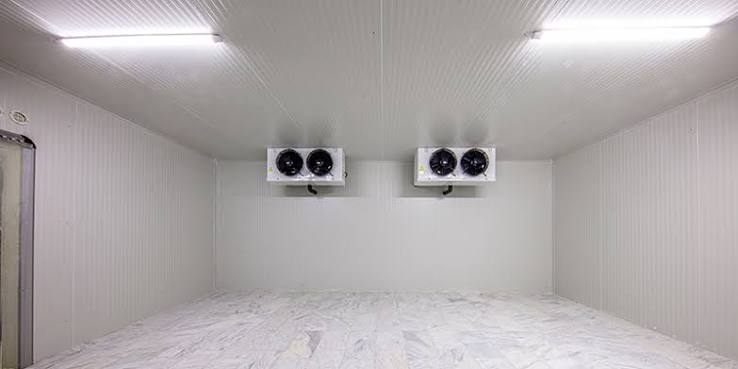
Why Insulation Matters in Cold Storage
Every watt of cooling energy your refrigeration system produces eventually escapes through the walls, ceiling, and floor. The job of the insulation is to slow that heat transfer as much as possible. Better insulation means your compressors run less, your electricity bills stay lower, and your temperature stays stable.
In cold storage, temperature stability is not optional. Even small fluctuations can cause condensation on walls and ceilings, which leads to ice buildup, mold growth, and structural damage over time. Consistent insulation prevents these problems by keeping the cold side and warm side of the wall properly separated.
Panel Thickness by Temperature Range
The target temperature of your cold room determines the minimum panel thickness you need. Here are the general guidelines used in the industry:
- Chilled rooms (0 to +5 degrees Celsius): 60 to 80mm panel. Used for fresh produce, dairy, beverages, and pharmaceutical storage.
- Deep chill rooms (-10 to -5 degrees Celsius): 80 to 100mm panel. Used for meat and fish storage before freezing.
- Deep freeze rooms (-25 to -18 degrees Celsius): 100 to 120mm panel. Standard frozen food storage.
- Ultra-low temperature rooms (-40 to -30 degrees Celsius): 120 to 150mm panel. Used for ice cream, pharmaceutical cold chains, and specialized applications.
These are minimum recommendations. In hot and humid climates like Bangladesh, where outside temperatures can exceed 35 degrees Celsius with high humidity, going one thickness step above the minimum is often a wise investment. The small additional cost in panel pays back quickly in energy savings.
Why PUF is the Standard for Cold Rooms
For cold storage applications, polyurethane foam (PUF) has become the industry standard, and for good reason. PUF has a thermal conductivity of 0.022 to 0.025 W/mK, which is significantly better than EPS (0.035 to 0.040) or Rockwool (0.040 to 0.045).
The practical benefit is that you can use thinner PUF panel to achieve the same insulation value as thicker alternatives. A 100mm PUF panel provides roughly the same thermal resistance as a 150mm EPS panel. That means more usable space inside the cold room and less structural load on the building frame.
PUF also has a closed-cell structure that naturally resists moisture absorption. In cold storage, where condensation and moisture ingress are constant concerns, this is a significant advantage over open-cell materials.
Moisture Resistance and Vapor Barriers
Moisture is the enemy of cold storage insulation. When warm, humid air reaches a cold surface, it condenses. If that moisture gets into the insulation core, its thermal performance drops dramatically. Wet insulation can lose 40 to 50 percent of its insulating ability.
The steel facing on Sandwich Panel acts as the primary vapor barrier. For cold rooms, the facing should be on the warm side of the panel, and all joints must be sealed to prevent air infiltration. This is one area where installation quality makes a real difference.
In ultra-low temperature applications, additional vapor barrier measures may be needed. Some facilities use a separate polyethylene vapor barrier behind the panel, or apply sealant at every joint and penetration point to create a continuous air barrier.
Joint Sealing Systems
The joints between panel are the weakest point in any cold room envelope. Heat and moisture can bypass the panel insulation entirely through poorly sealed joints. There are two main approaches to panel joints:
Cam-lock joints use a mechanical locking system built into the panel edges. The panel click together and are held in place by internal cam mechanisms. This system provides consistent joint tightness and is faster to install. Most cold room manufacturers in Bangladesh use cam-lock systems for their standard product lines.
Plug-in joints use tongue-and-groove profiles that interlock when panel are pushed together. These joints rely on gaskets and sealant for airtightness. They work well but require more careful installation to ensure proper sealing.
Regardless of the joint type, a bead of silicone sealant should be applied at every joint to ensure airtightness. This is not optional for cold storage. Even a small air leak can cause ice buildup, increased energy consumption, and premature insulation failure.
ASHRAE U-Value Targets
ASHRAE, the American Society of Heating, Refrigerating and Air-Conditioning Engineers, publishes recommended U-values for cold storage construction. U-value measures the rate of heat transfer through the building envelope, with lower values indicating better insulation performance.
Here are the general ASHRAE targets for cold storage walls:
| Application | Target U-value (W/m2K) |
|---|---|
| Chilled storage (0 to +5C) | 0.25 to 0.35 |
| Frozen storage (-18 to -12C) | 0.15 to 0.25 |
| Deep freeze (-25 to -18C) | 0.10 to 0.15 |
| Ultra-low (-40C and below) | 0.07 to 0.10 |
For the ceiling, ASHRAE recommends values about 20 to 30 percent better than wall targets, since heat rises and ceiling losses tend to be higher. Floor insulation is equally important in cold storage to prevent ground heave from frozen soil beneath the building.
Common Mistakes to Avoid
From our experience installing cold rooms across Bangladesh, here are the mistakes we see most often:
Using the wrong panel thickness to save money. A thin panel saves a small amount upfront but increases energy costs every month. Over a five year period, the energy waste from an undersized panel far exceeds the initial savings.
Poor joint sealing. Panel may be the right thickness, but if the joints are not properly sealed, cold air leaks in and warm air penetrates the insulation. This causes ice buildup at the joints, which progressively damages the seal and makes the problem worse.
Ignoring the floor. Many cold rooms are built with insulated walls and ceiling but an uninsulated floor. The floor is a major source of heat gain, especially in deep freeze applications where the cold penetrates into the ground.
Inadequate thermal break at the foundation. The concrete slab under a cold room must be thermally isolated from the surrounding ground. Without a thermal break, cold migrates through the slab into the foundation, causing frost heave and structural damage.
Planning Your Cold Storage Project
Choosing the right insulation starts with understanding what you need to store, what temperature range is required, and how the facility will be used. A cold room for fresh vegetables has different requirements than one for frozen fish or pharmaceutical products.
At RPS Construction, we manufacture PUF Sandwich Panel specifically designed for cold storage applications. Our panel come in thicknesses from 50mm to 150mm with cam-lock joint systems and pre-painted steel facings. We handle the full process from panel supply to professional installation, including vapor barrier detailing and joint sealing.
Contact us to discuss your cold storage project. We can help you determine the right panel specification and provide a detailed quote based on your facility dimensions and temperature requirements.