EPS packaging is one of the most widely used protective materials in the world. If you have ever unpacked a refrigerator, a television, or any fragile electronic device, chances are you have held a piece of expanded polystyrene in your hands. It is lightweight, affordable, and surprisingly effective at absorbing impact.
In this guide, we will walk you through everything about EPS packaging. What it is, how it is manufactured, the different types you will find in the market, and why it remains the go-to choice for protecting products during storage and shipping.
What is EPS Packaging
EPS stands for Expanded Polystyrene. It is a rigid, closed-cell foam made from small polystyrene beads that are expanded using steam heat. During manufacturing, the beads are heated in a mold, causing them to swell and fuse together into a solid shape. The result is a material that is about 98 percent air and only 2 percent polystyrene.
This air-filled structure is what makes EPS so effective. Each tiny bead acts like a miniature air cushion. When something hits the packaging, the energy gets absorbed by thousands of these air pockets rather than transferring to the product inside. That is why a refrigerator sitting inside an EPS cradle can survive a drop from a truck without a scratch.
EPS packaging is also moisture resistant, chemically stable, and does not rot or support mold growth. These properties make it suitable for everything from dry electronics to wet fish cold boxes.
How EPS Packaging is Made
The manufacturing process starts with raw polystyrene beads, usually about 0.5 to 1.5 millimeters in diameter. These beads contain a blowing agent, typically pentane, which allows them to expand when heated.
Pre-expansion: The raw beads are fed into a pre-expander where steam heat causes them to swell to 20 to 50 times their original size. The operator controls the temperature and time to achieve the target density. For most packaging applications, this falls between 15 and 25 kilograms per cubic meter.
Stabilization: After pre-expansion, the beads are stored in large silos for several hours. This allows air to diffuse back into the cells and stabilizes the internal pressure. Skipping this step leads to uneven density and weaker final products.
Molding: The stabilized beads are fed into aluminum molds shaped to match the product being packaged. Steam is injected through the mold walls, causing the beads to expand further and fuse together. After cooling, the finished packaging piece is ejected from the mold.
CNC trimming: Some packaging designs require additional cuts, holes, or channels. A CNC hot wire cutter or router trims the molded pieces to precise dimensions so they fit perfectly around the product.
Density Requirements for Packaging
Density is one of the most important factors in EPS packaging. It determines how strong the packaging is, how much weight it can support, and how well it absorbs impact. Here is what you need to know:
15 to 18 kg/m3: This range works for lightweight products like ceiling fans, light fixtures, and small electronics. The packaging provides basic cushioning without adding unnecessary weight.
18 to 22 kg/m3: The sweet spot for most household appliances including televisions, air conditioners, and small refrigerators. This density offers a good balance between cushioning performance and cost.
22 to 25 kg/m3: Used for heavy appliances like large refrigerators, washing machines, and industrial equipment. The higher density provides better compression strength and impact absorption for heavier loads.
Getting the density right matters. Too low and the packaging will crush under the product weight during stacking. Too high and you are paying for material you do not need, and the packaging becomes rigid rather than cushioning.
Types of EPS Packaging
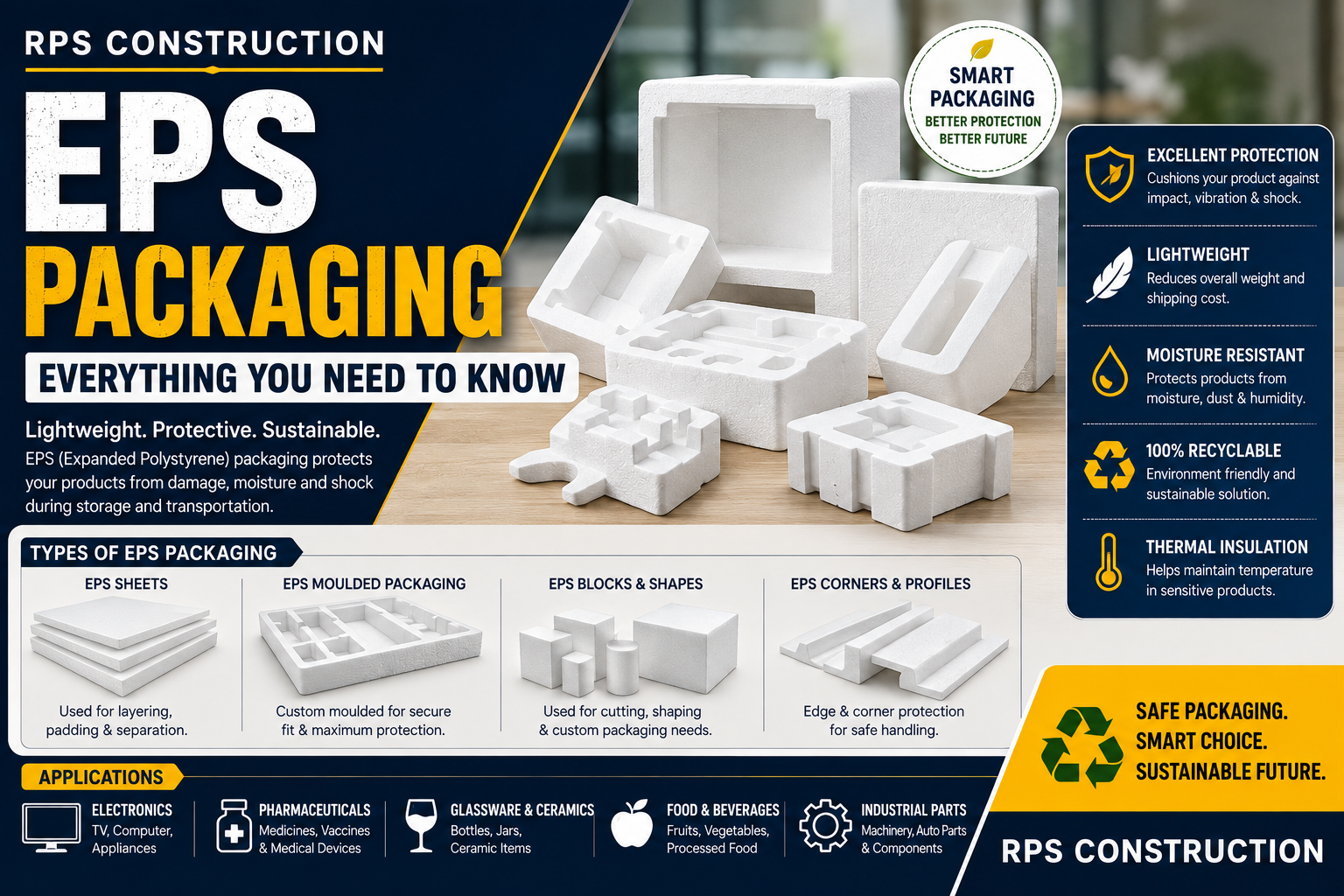
EPS packaging comes in many forms depending on what it needs to protect. Here are the most common types you will encounter:
Refrigerator Packaging
Refrigerator packaging is probably the most recognizable form of EPS. It typically consists of four corner pieces or two full cradles that hold the refrigerator suspended inside the carton. The design must support the full weight of the unit while also absorbing shocks from tipping and vibration during transit. Density for refrigerator packaging is usually in the 20 to 25 kg/m3 range to handle the weight.
AC Unit Packaging
Air conditioner packaging follows a similar approach to refrigerator packaging but is tailored to the specific dimensions and weight distribution of AC units. Split AC indoor units typically use lighter EPS cradles, while outdoor compressor units need denser foam to protect the heavier compressor components.
Television Packaging
Television packaging faces a unique challenge. The screen is fragile and the unit is wide and flat. EPS corner protectors and edge guards must distribute impact forces evenly across the panel rather than concentrating stress at any single point. Modern TV packaging often combines EPS corners with cardboard frames for added rigidity.
Fish Cold Boxes
Fish cold boxes are a different beast entirely. These are not about impact protection but about temperature control. EPS fish boxes are typically molded as single-piece containers with thick walls. The low thermal conductivity of EPS keeps fish fresh during transport from landing sites to markets. Wall thickness ranges from 30 to 80 millimeters depending on how long the fish needs to stay cold.
Ceiling Fan Packaging
Ceiling fan packaging uses molded EPS inserts that hold the motor housing, blades, and hardware separately within the carton. The packaging must prevent parts from contacting each other during transit. Because ceiling fans are relatively light, the density used is typically in the lower range of 15 to 18 kg/m3.
Pharmaceutical and Medicine Boxes
Pharmaceutical EPS packaging is designed for temperature sensitive medicines and vaccines. These boxes often combine EPS insulation with gel packs to maintain specific temperature ranges during shipping. The walls are thicker, typically 40 to 60 millimeters, and the density is higher to ensure consistent thermal performance. Medical packaging must also meet cleanliness standards since EPS does not shed fibers or particles.
Why EPS Protects Fragile Items
There are three main mechanisms that make EPS effective at protecting products:
Cushioning. When an impact occurs, the cellular structure of EPS compresses gradually, absorbing energy over a longer period than a rigid material would. This reduces the peak force transmitted to the product. The slower the deceleration, the less damage to the item inside.
Distribution of forces. EPS packaging is designed to spread impact forces over a larger area. Instead of a point load hitting one spot on the product, the foam distributes the force across the entire contact surface. This prevents localized damage like dents and cracks.
Vibration damping. During transport, vehicles create continuous vibration that can damage sensitive components. EPS dampens these vibrations, reducing the amplitude of movement transmitted to the product. This is especially important for electronics with delicate circuit boards and connectors.
Custom Mold Design
Off the shelf EPS shapes like sheets and blocks have their place, but custom molded packaging is where the real value lies. A custom mold is designed to match the exact geometry of the product being shipped. Every corner, every protrusion, every weight distribution point is accounted for in the mold design.
The mold design process typically starts with a 3D scan or CAD model of the product. Engineers then design the packaging around it, calculating wall thicknesses, cushion depths, and draft angles. A prototype mold is usually made from aluminum and tested before full production begins.
Custom molds make economic sense when you are shipping more than a few thousand units. The upfront mold cost, which can range from a few hundred to several thousand dollars depending on complexity, gets spread across the production run. For high volume products like appliances and electronics, the per unit packaging cost drops significantly compared to generic alternatives.
Getting Started with EPS Packaging
Whether you are shipping refrigerators across the country or sending vaccines to remote clinics, the right EPS packaging makes the difference between products arriving intact or arriving damaged. The key is matching the density, design, and wall thickness to your specific product and shipping conditions.
At RPS Construction, we manufacture custom EPS packaging for a wide range of industries in Bangladesh. From refrigerator cradles to pharmaceutical cold boxes, our team designs and produces packaging that protects your products throughout the supply chain.
Contact us to discuss your packaging requirements and get a custom solution designed for your products.