
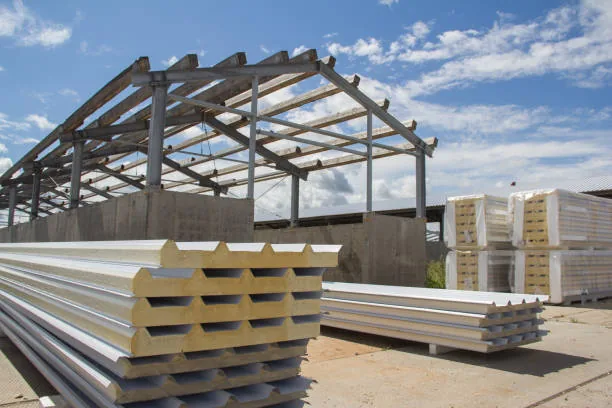
Sandwich Panel for Cold Storage and Clean Rooms
The most demanding jobs in panel construction - and why PU panel handle them best.
Why Sandwich Panel dominate cold storage construction
Cold storage demands three things from a wall: continuous insulation, an unbroken vapour barrier and cleanable surfaces. Sandwich Panel deliver all three in one factory-made component. There is no masonry to sweat, no plaster to crack and no air path through the wall - as long as the core and joints are chosen correctly. This page covers what matters when building cold storage and clean rooms in Bangladesh, and how to specify the right Sandwich Panel for each zone.
Which core for which temperature?
| Application | Suggested core | Why |
|---|---|---|
| Dry store above 0 °C | EPS | Budget option where moisture and fire rules allow |
| Chiller 0 to 10 °C | PU | Closed-cell core resists condensation |
| Freezer -10 to -25 °C | PU, thicker panel | Lowest thermal conductivity, vapour-tight skin |
| Fire-rated cold store | Rockwool | Non-combustible core where code demands it |
Thickness follows temperature: deeper freezers need thicker PU panel to hold the gradient. Tell us the design temperature and we will size the panel correctly - see panel thickness options on the specifications page.
Sizing cold room panel by design temperature
Two jobs are often confused: keeping the cold in, and keeping the moisture out. Insulation thickness is sized from the design temperature and ambient conditions - a 5 °C chiller in Dhaka's summer needs less panel than a -20 °C blast freezer. The vapour barrier is separate and unforgiving: a cold wall meeting warm, humid air will sweat wherever the barrier is broken, including at screw penetrations and panel ends. Thickening the panel never fixes a broken vapour seal, so the skin, joints and trim schedule are as important as the millimetres of foam.
The joints are the weak point - always
No panel leaks through its face; it leaks through its joints. Cold room failures trace back to joints that were not sealed, not cam-locked, or not continuous to a vapour-tight floor junction. Installation crews must follow the joint schedule exactly, seal as each joint closes, and tie the wall corners and floor junction into the same vapour barrier. This is not a step to improvise - see our installation process guide for what professional work looks like.
Clean room panel requirements
- Hygienic surfaces. Smooth, closed steel faces wash down cleanly; food and pharma environments should avoid textured finishes that trap particles.
- Sealed fillets and coves. Wall-to-floor and wall-to-ceiling junctions use coved trims so nothing collects in corners.
- Tight joint lines. Panel joints are sealed and finished flush to eliminate ledges where dust settles.
- Flush fixtures. Lighting and services are integrated in the panel schedule, not drilled through afterwards.
Skin coating matters as much as the core
In humid, wash-down environments the exterior skin performs best with a corrosion-resistant coating. Specify the skin grade with your supplier - a few taka more per square foot here prevents rust blooms five years later, especially in coastal areas.
Get a panelling plan for your facility
RPS Construction has supplied and installed cold storage and clean room envelopes across Bangladesh - from small 0 °C fruit stores to multi-chamber freezers and hygienic production halls. Send us the room dimensions, design temperature and hygiene class, and we will return a panel layout, core recommendation and written price. Request your quote today - we reply within one working day.
Retrofitting an existing room into a cold room
Not every cold room is built from scratch. Many Bangladeshi facilities convert an existing hall or masonry room by lining it with PU panel: a continuous insulated envelope is installed inside the walls and under the ceiling, with a sealed vapour barrier and a proper cold room door. Retrofits are faster and cheaper than new construction, and the panel work is identical in discipline - joints sealed, corners coved, openings flashed. Send us your existing room dimensions and target temperature, and we will price the retrofit envelope as a complete package.